Solid Entry-Level GPS Watch for Ruck Training
The Forerunner 55 strips away distractions to focus on what matters: accurate GPS tracking, heart rate monitoring, and two-week battery life. At $168, it's Garmin's budget play for runners who want reliable data without paying for features they won't use.
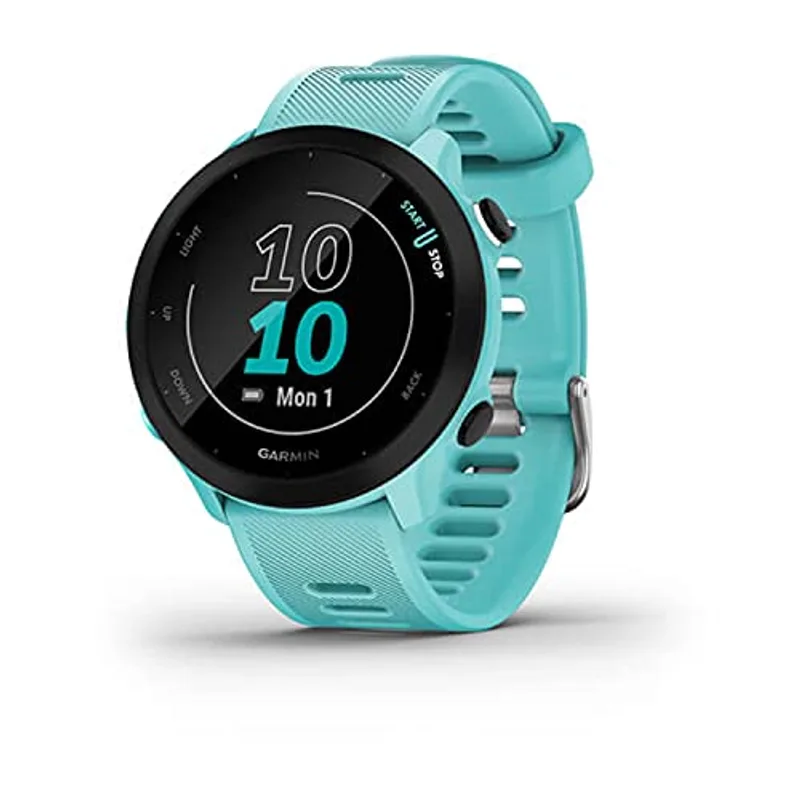
A capable GPS watch for ruckers who prioritize simplicity and battery life over advanced metrics. The price is right, but the basic feature set leaves room for growth as your training evolves.
Best for: Budget-conscious ruckers who need reliable GPS and long battery life
Check Price — $199.00Specifications
| Price | $199.00 |
| Weight | 0.08 lbs |
| Dimensions | 0.5H x 1.7W x 1.7L in |
Durability
Garmin doesn't specify the material, but the Forerunner 55 uses a polymer case typical of entry-level GPS watches. At 0.08 pounds, it's light enough to forget you're wearing it, though that lightness comes with a tradeoff in ruggedness compared to Fenix or Instinct models.
The watch is water-rated for pool swimming, which means it handles sweat and rain without issue. We'd expect normal wear and tear to show on the screen and bezel after months of heavy use. The silicone band holds up well to repeated exposure to moisture and dirt, though it's not reinforced like higher-tier Garmin straps.
Comfort
At just over an ounce, the Forerunner 55 disappears on your wrist during long rucks. The slim profile doesn't catch on plate carrier straps or pack hip belts, which is a real advantage when you're carrying weight.
The silicone band flexes enough to stay comfortable through temperature swings and wrist swelling during exercise. The watch face sits flat against your wrist rather than protruding like bulkier multisport watches. For ruckers with smaller wrists or those who don't want a chunky tactical watch, this is one of the most comfortable options in the Garmin lineup.
Features
The Forerunner 55 covers the fundamentals: GPS distance tracking, wrist-based heart rate, and PacePro for race planning. Daily suggested workouts adapt to your fitness level, which helps if you're building a structured ruck training program. The built-in activity profiles include running, cycling, and HIIT, though there's no dedicated rucking mode.
Battery life is the standout feature. Two weeks in smartwatch mode means you're not charging constantly, and 20 hours of GPS tracking covers most ultra-distance events. The wellness features like fitness age and respiration tracking add context to your training load, though serious athletes will miss advanced metrics like training load balance and recovery advisor found on pricier models.
Value
At $168, the Forerunner 55 undercuts most GPS watches with comparable battery life and Garmin's ecosystem. You're getting proven GPS accuracy, Connect IQ customization, and enough features to track progression without paying for triathlon tools you don't need.
The value proposition weakens if you plan to expand beyond basic cardio tracking. There's no barometric altimeter for elevation gain, no advanced running dynamics, and no mapping features. For ruckers just starting to track workouts, this is a smart entry point. If you're already logging structured training and want deeper metrics, save for a Fenix or Instinct model with better durability and feature depth.
Pros & Cons
Pros
- ✓ Two-week battery life in smartwatch mode eliminates constant charging
- ✓ Lightweight design at 0.08 lbs doesn't interfere with pack straps
- ✓ PacePro feature helps plan pacing strategy for ruck events
- ✓ Daily suggested workouts adapt to your fitness level and recovery
- ✓ Connect IQ customization lets you tailor data fields and watch faces
- ✓ Sub-$200 price point makes GPS tracking accessible
Cons
- ✗ No barometric altimeter for accurate elevation tracking during rucks
- ✗ Basic polymer construction less rugged than Fenix or Instinct models
- ✗ Missing advanced metrics like training load balance and recovery advisor
- ✗ No dedicated rucking activity profile in default settings
Frequently Asked Questions
Does the Forerunner 55 track elevation gain during rucks?
No, it uses GPS-based elevation which is less accurate than models with barometric altimeters. Expect elevation data to be approximate rather than precise.
Can I create a custom rucking activity profile?
Not directly on the watch. You can use the Track Run or Hike profile and manually log it as rucking in Garmin Connect after the workout.
How accurate is the wrist-based heart rate during weighted rucks?
Wrist-based optical sensors can lose accuracy when pack straps restrict blood flow or during high-intensity intervals. For precise heart rate data under load, pair with a chest strap.
Will this watch survive a GORUCK event?
It's water-resistant and handles basic abuse, but the polymer case is more vulnerable to impact damage than ruggedized models. Consider a screen protector if you're doing events with heavy obstacles.
How does battery life compare to Apple Watch for all-day ruck events?
The 20-hour GPS mode easily outlasts Apple Watch's 6-8 hours, making it viable for ultra-distance events without mid-event charging.