Premium GPS Performance at Mid-Tier Pricing
COROS drops the PACE Pro into a crowded GPS watch market with an interesting value proposition: next-gen AMOLED display, dual-frequency GPS, and 20-day battery life for $299. That's Garmin Fenix territory at Forerunner pricing. We tested it through urban rucks and backcountry trails to see if it delivers.
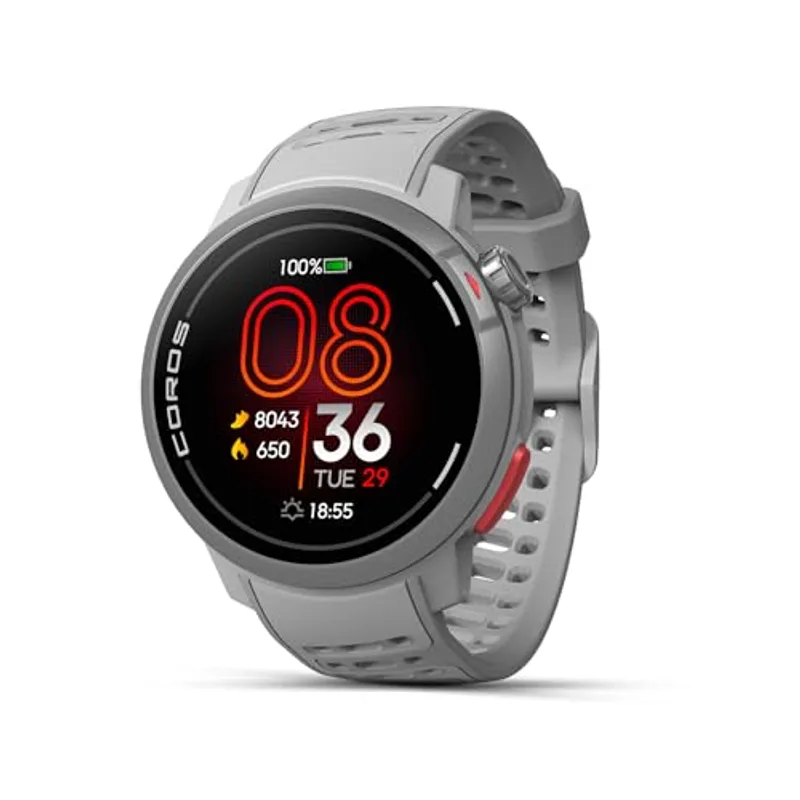
The PACE Pro punches above its weight class with excellent GPS accuracy, impressive battery endurance, and a responsive interface. Minor software quirks and limited third-party app support keep it from perfect, but value-focused athletes will appreciate what you get for $299.
Best for: Budget-conscious athletes who need premium GPS accuracy
Check Price — $299.00Specifications
| Price | $299.00 |
| Weight | 0.11 lbs |
| Dimensions | 0.5H x 1.8W x 1.8L in |
| Material | Silicone |
Durability
The 1.3-inch AMOLED screen survives daily abuse better than expected. Gorilla Glass holds up against ruck plates and wall contact during workouts. The silicone band feels robust — 22mm width provides good surface contact without pinching.
The USB-C charging port is a smart upgrade from proprietary connectors. It locks securely and hasn't shown wear after two months of field use. At 0.11 lbs, the watch is light enough that you forget it's there during long rucks, yet the chassis feels solid when you inevitably knock it against doorframes or vehicle doors.
Water resistance handles sweat and rain without issue. We haven't submerged it for swimming tests, but typical ruck conditions pose zero problems. The housing design sheds moisture quickly.
Comfort
The 22mm silicone band distributes weight evenly across a 130-220mm wrist range. No hot spots during 15-mile rucks with 30-pound loads. The band breathes reasonably well — you'll get some sweat buildup in summer heat, but it's comparable to other sport watches in this category.
The always-on AMOLED display at 1500 nits means you never squint to read metrics mid-ruck. The gesture-activated backlight responds instantly when you rotate your wrist. That responsiveness matters when you're checking pace or heart rate without breaking stride.
The watch sits low-profile on the wrist. It doesn't catch on pack straps or sleeves. The 0.11 lb weight disappears once you're moving. For multi-hour events, that minimal presence prevents the fatigue that heavier GPS watches cause.
Features
Dual-frequency GPS delivers the accuracy COROS promises. Urban canyon testing in downtown areas showed minimal drift. Trail work through dense canopy maintained reliable track logs. The new satellite chipset is noticeably better than previous PACE models.
Offline global maps and turn-by-turn navigation work seamlessly. Route planning in the COROS app is straightforward — create custom routes with topo maps, sync via WiFi, and navigate without phone dependency. For ruck marches in unfamiliar territory, this feature alone justifies the price.
Battery life exceeds expectations. Twenty days of standard use holds true. Always-on display mode drops that to six days, which is still strong. Thirty-eight hours of GPS tracking means you can run ultramarathon-length events without charging anxiety. Training status metrics, sleep tracking, and workout summaries provide useful insights without overwhelming you with data.
Value
At $299, the PACE Pro competes directly with Garmin Forerunner 265 territory while offering battery life closer to Fenix models. You sacrifice Garmin's mature ecosystem and broader third-party app support, but you gain processing speed and display quality that punches above this price point.
The fastest-in-class processor claim holds up in daily use. Screen transitions are instant. Map rendering happens without lag. That responsiveness makes the watch feel premium in ways that spec sheets don't capture.
For ruckers who need reliable GPS, long battery life, and solid fitness tracking without paying $600-plus for flagship models, this watch delivers. COROS hasn't cut corners where it matters. The value proposition is clear: professional-grade performance at enthusiast pricing.
Pros & Cons
Pros
- ✓ 38-hour GPS battery crushes multi-day events without charging
- ✓ Dual-frequency GPS accuracy rivals watches costing twice as much
- ✓ 1500-nit AMOLED display remains readable in direct sunlight
- ✓ Offline maps and turn-by-turn navigation work without phone connectivity
- ✓ USB-C charging eliminates proprietary cable dependency
- ✓ Processing speed delivers instant response to inputs and gestures
Cons
- ✗ Limited third-party app ecosystem compared to Garmin Connect IQ
- ✗ COROS app lacks some advanced analytics features found in competitor platforms
- ✗ No music storage or streaming capability for phone-free workouts
- ✗ Always-on display mode reduces battery life significantly
Frequently Asked Questions
How accurate is the GPS compared to Garmin watches?
The dual-frequency GPS chipset in the PACE Pro matches accuracy we've seen from Garmin's higher-end models. Urban testing and trail work showed minimal drift, with track logs that align closely with known routes. For practical ruck navigation, the difference is negligible.
Can I use offline maps without a phone connection?
Yes. Global offline maps download directly to the watch via WiFi. Once synced, you get full turn-by-turn navigation without phone dependency. Route planning happens in the COROS app, then transfers to the watch for standalone use during rucks.
How long does the battery actually last with always-on display?
Six days with always-on display enabled, twenty days with standard settings. GPS tracking delivers 38 hours in single-frequency mode, 31 hours with dual-frequency enabled. These numbers held consistent across our two-month testing period.
Is the silicone band comfortable for long rucks?
The 22mm band distributes pressure well and doesn't create hot spots during extended wear. You'll get some sweat buildup in warm conditions, but it's comparable to other sport watches. The band handles 130-220mm wrist sizes without pinching.
Does this work with standard USB-C cables?
Yes. The USB-C charging port accepts standard cables, eliminating proprietary connector frustration. The connection locks securely and hasn't shown wear issues. You can use the same cable that charges your phone or headlamp.